Sport shooting: discipline, precision and heritage

Sport shooting: discipline, precision and heritage

In the public imagination, shooting is often associated with hunting. Yet, behind every effective hunter, there is almost always a disciplined shooter. Sport shooting, far from the stereotypes, is a school of rigor, control, and precision. It is there that the automatic reflexes are forged which, later, will make all the difference in the field.
Target shooting is not simply a leisure activity. It is a structured, regulated, demanding sport where every detail counts and where safety is never negotiable.
A master's school first and foremost
Sport shooting rests on solid foundations:
Position, breathing, relaxation control, target reading, and stress management. Regardless of the discipline, the principle remains the same: repeating a perfect movement in a controlled environment.
That's exactly what serious hunters are looking for. Before judging a distance, an angle, or a shooting window in the forest, you have to have learned to judge yourself.
Precision shooting: the foundation of everything

Precision shooting is often the gateway to the world of sport shooting. Fixed targets, standardized distances, a stationary shooter: everything is designed to eliminate chance.
It includes:
the 10m air rifle,
the 10m pistol,
the 50m rifle in different positions.
These disciplines, overseen by the International Shooting Sport Federation, produce remarkably consistent shooters. For a hunter, this is where the true understanding of the perfect shot is developed.
Dynamic shooting: when the decision matters as much as the shot.
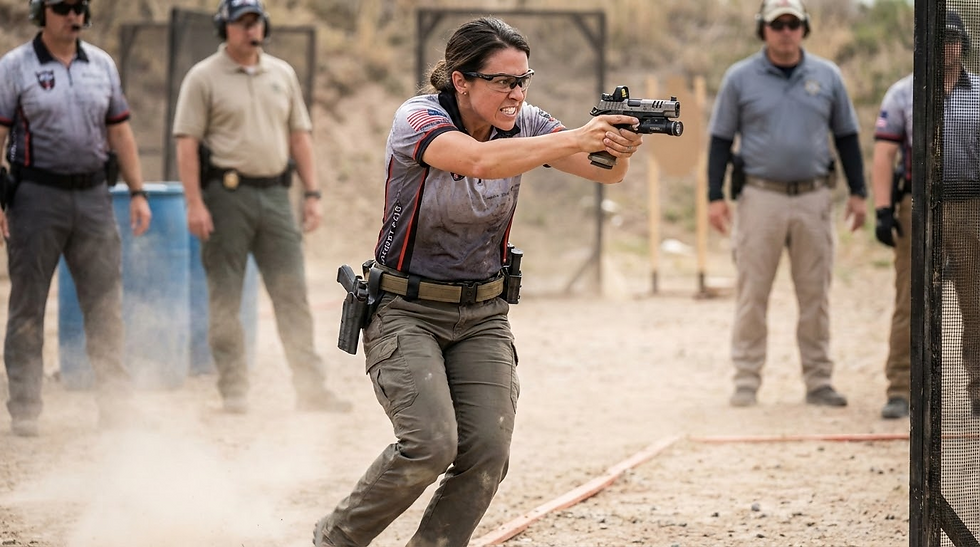
In contrast to static shooting, dynamic shooting puts the shooter in motion. Courses, obstacles, multiple targets, timers: everything encourages quick decision-making.
The best-known discipline is IPSC, where a constant balance between speed, accuracy, and control is assessed.
For the hunter, it's an exceptional school:
adrenaline management,
finger discipline
target prioritization,
Strict adherence to safety angles.
Long-range shooting: the applied science

Long-range shooting is undoubtedly the most fascinating. Here, the bullet leaves no room for error. Wind, temperature, angle, ballistics: everything must be anticipated.
Distances from 300m to over 1000m, high-precision optics, ballistic tables and terrain reading are part of the daily routine. It's a thoughtful, methodical shot, where patience is a virtue.
For hunters of wide open spaces, it is a discipline that demands humility and absolute respect for personal limits.
Rifle shooting: instinct and fluidity

Trap, skeet, sporting clays: rifle shooting relies on moving targets. Here, there are no reticles or calculations. Everything depends on hand-eye coordination, swing, and timing.
This discipline most closely resembles hunting migratory birds. It develops:
the fluidity of movement,
reading trajectories,
consistency under pressure.
Much more than a sport

Sport shooting is also a culture. A culture of safety, knowledge transfer, and respect. Shooting ranges are often places where generations and experiences intersect, where veterans pass on reflexes that can't be learned from books. Contrary to popular belief, sport shooting is one of the most regulated sports. Each discipline is based on strict rules, mandatory training, and the constant accountability of its participants.
For the hunter, sport shooting is not a parallel activity. It is a natural extension. It is where one refines one's techniques, where one learns self-control before claiming to master a shot in a real situation.
Before the forest, before the ambush, before the decisive moment…
There is always a shooting range.


Comments